
A WWII Giant Beneath the Tropical Surface
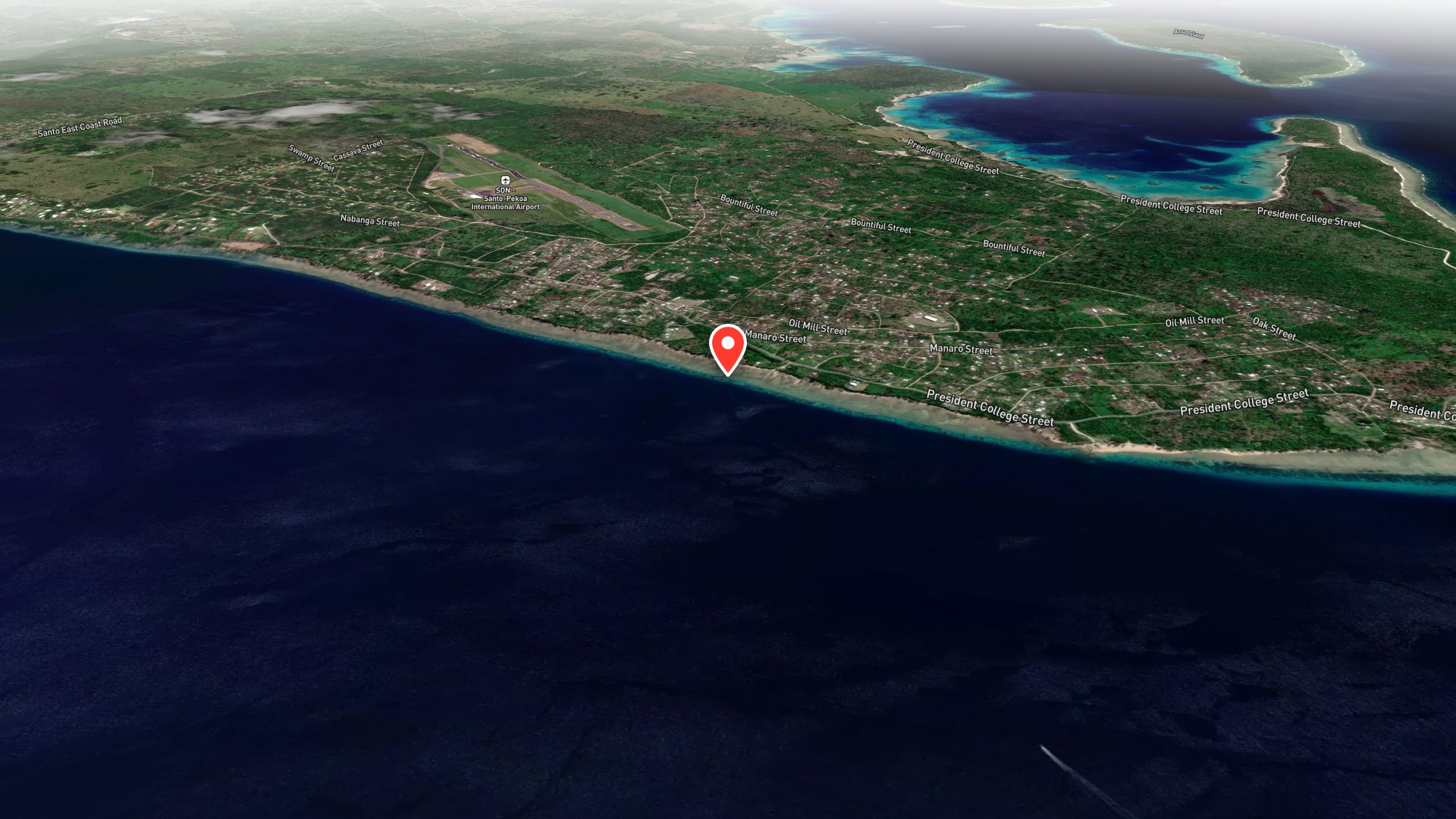
The SS President Coolidge began life as an American luxury cruise liner running passengers between California and Japan, before being requisitioned as a military troopship during World War II. On her approach to Santo on 26 October 1942, Captain Henry Nelson — fearing Japanese submarines and unaware of the minefields — tried to enter the harbour through the largest and most obvious channel. Almost all aboard escaped as she slowly settled near a shallow reef. Today she is one of the best shore wreck diving sites in the world, accessible to divers of all levels, with the ship lying from 20 m to 70 m.
Conditions & Access
Currents are often calm with minimal movement at depth, making the Coolidge unusually forgiving for a wreck of this scale. Water temperatures stay consistently warm, generally 26–27 °C, providing a comfortable environment for the extended bottom times typical of wreck exploration. Visibility ranges from 10 to 30 metres. The wreck is accessed directly from the beach — a gentle sandy slope brings you down to the bow starting at 21 metres. There is no true "bad season" here — the water never gets cold, making this a genuine year-round destination.
Marine Life
The ship is covered in both hard and soft corals, and before you even enter the interior you'll be greeted by triggerfish, lionfish, nudibranchs, and a resident green moray eel, all in glaring contrast to the cannons they adorn and inhabit. Don't be surprised to encounter reef fish, barracuda, and sea turtles, as well as an anemone garden teeming with clownfish — and if fortune smiles, a glimpse of the legendary resident moray eel known to locals simply as "Nessie".
Diving the Coolidge: Who Is It For?
With a planned maximum depth of 21 m on the orientation dive, even beginner divers can join. The cargo dive is for advanced divers — entering through one of the gates in the hull for an impressive vertical descent into the enormous Cargo 2 hold, where jeeps at 30 m remain in remarkable condition. Technical diving certifications become essential for those aiming to reach deeper sections, such as the engine room at around 45 m or the stern at 60–70 m. Almost all dives are conducted as decompression dives, so careful planning and familiarity with deco procedures are strongly advised.
Recommended ISC Certifications
Deep Diver — The ISC Deep Diver course teaches you to dive efficiently and safely to 30 m or 40 m, whether your interest is marine life, exploring a specific wreck dive site, or just the mystique of the deep blue. Essential for reaching the Coolidge's cargo holds, The Lady, and the engine room.
Wreck Diver — Advance your skills with the ISC Wreck Diver course, covering safe navigation of overhead environments and responsible interaction with protected historic wrecks — perfectly matched to the Coolidge's protected status.
Advanced Wreck Diver — Take your wreck diving to the next level with the ISC Advanced Wreck Diver course and penetrate the wreck within the light zone. Ideal for divers ready to explore the Coolidge's deeper interior passages and cargo holds.
Night Diver — Available through ISC, this course prepares you for the extraordinary flashlight-fish displays and altered ambience of a night dive inside the Coolidge's cargo holds.
Nitrox Diver — Also available through ISC, enriched air extends your allowable bottom time on the shallower sections of the wreck — a genuine advantage when you want to linger over The Lady or the coral-clad starboard hull.